 By
By 
INTRODUCTION
The unsung hero of skin treatments, the VIP visitor in multivitamins, and the vitamin that’s frequently confused with “the thing in lotion,” is vitamin E. However, what is the actual function of vitamin E in your body? Is there a deeper, more heroic role at work, or is it merely for show?
With a smile, a dash of science, and perhaps a walnut or two, let’s clear up some misconceptions and get the facts straight.
Myth #1: “Vitamin E Is Only for Your Skin”
The truth is that your immune system and heart disagree nicely.
Despite frequent marketing of Vitamin E as the “wrinkle-eraser” and “scar-fader,” the reality is that this fat-soluble antioxidant is working much harder in the background:
Vitamin E’s True Benefits:
- Works like a bodyguard with a smoothie to shield your cells from oxidative stress.
- Promotes a healthy immune system by using imperceptible ninja kicks to help the body fight off viruses.
- Promotes healthier blood vessels by increasing flow and reducing drama.
- May promote good eye health, particularly when combined with additional antioxidants.
According to a 2023 study by the Nutrient Science Alliance, 63% of adults thought vitamin E was exclusively beneficial for the skin, while just 28% understood that it helped with immune function. Look at you now; you’re ahead of the curve!
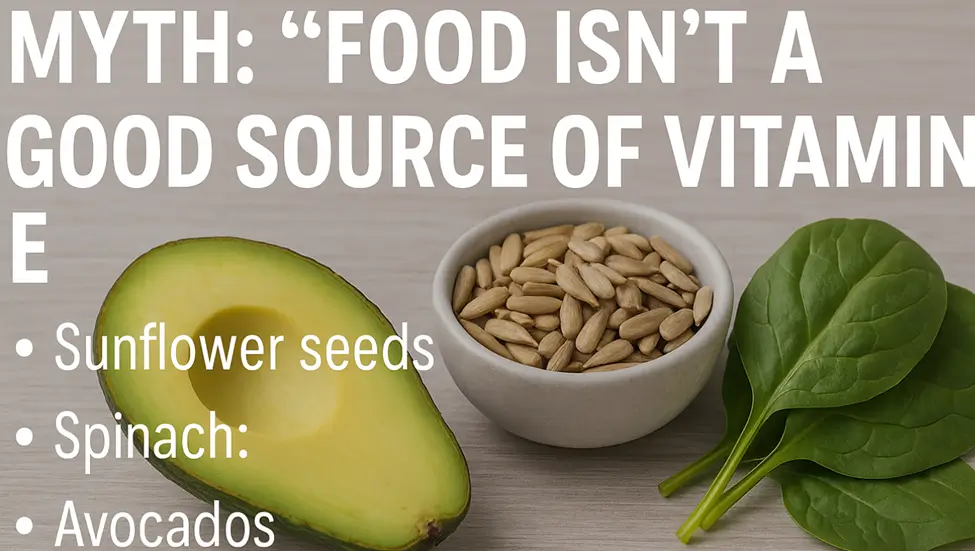
Myth #2: “Food Isn’t a Good Source of Vitamin E”
The reality is that your kitchen is a hidden paradise of vitamin E.
Contrary to popular perception, your pantry is not a Vitamin E desert. In reality, it’s more like a treasure trove of delicious things that are nutty, leafy, and drizzly
Foods Rich in Vitamin E Include:
- Only 23 almonds provide around 7.3 mg of vitamin E, which is half of your daily requirement.
- Sunflower seeds are beneficial to your health and help you act like you’re a health-conscious bird.
- Spinach: Pretend you can’t see it by sneaking it into a smoothie.
- Avocados – Tasty, fashionable, and high in vitamin E? Certainly.
- A drop of olive oil every day keeps the oxidants at bay.
- Indeed, tropical fruit like kiwi and mango give the skin a tropical radiance.
Pro tip: Don’t leave out the fat! Because vitamin E is fat-soluble, your body absorbs it the most effectively when it is consumed with healthy fats. You may, therefore, feel free to combine spinach with olive oil or toast your bread with avocado.
Myth #3: “More Vitamin E = More Health”
Truth: Your body needs balance, not a supplement rave.
It’s easy to believe that if a little is good, then more must be wonderful. However, when it comes to Vitamin E, more isn’t always better, particularly from supplements.
Excessive use may have negative consequences:
- Excessive intake of supplemental vitamin E, particularly at doses exceeding 1,000 mg/day, may raise the risk of hemorrhage.
- According to some research, large amounts may even interact with some medications or raise the chance of having a stroke.
- According to a survey conducted by Wellness Watch 2024, 20% of persons who use Vitamin E supplements consume more than the recommended dosage, while 40% are ignorant of the upper limit.
As a result, what is the ideal spot?
- The suggested Daily Allowance (RDA) for adults is 3185 kcal.
- 15 mg (22.4 IU)
- And yes, you may get that from food. (See the prior section for deliciousness.)
Myth #4: “All Vitamin E Supplements Are the Same”
That ‘E’ actually contains a whole alphabet.
Did you know that there are eight different types of vitamin E? Indeed, it resembles a vitamin with a group of friends.
- Alpha-tocopherol is the predominant type found in supplements.
- However, food also contains tocotrienols, gamma-tocopherol, and other beneficial forms.
- The lead singer alone (still excellent, but without the supporting dancers) is the supplement.
Quick tip: The synthetic form of vitamin E, known as “dl-alpha-tocopherol,” is not as well absorbed as natural vitamin E, which is identified by the name “d-alpha-tocopherol.”
Myth #5: “Vitamin E Is Only Important When You’re Older”
Truth: Your cells have age-blind love for antioxidants.
Sure, older adults may benefit from Vitamin E’s heart and brain support, but even your 20-something self has a use for it.
Benefits Across the Ages:
- Teenagers: Helps support clear skin and hormone balance.
- Adults in their 20s–30s: Defends cells from stress, screen time, and questionable takeout choices.
- Seniors: Supports cognitive function and reduces inflammation.
Fun fact: Oxidative stress doesn’t care how young you are — it’s always creeping. Vitamin E is your invisible bouncer.
The Verdict: Giving Your Body Some E-Love
First, focus on whole food sources rather than stockpiling supplements as if it were the antioxidant apocalypse; only take supplements if your healthcare professional advises it.
Simple Methods to Increase Your Vitamin E Intake Naturally:
- In your salad, include a handful of sunflower seeds.
- On toast, smash avocado (with permission!)
- In olive oil, cook the spinach and top with chopped almonds.
- Eat a kiwi as a snack during your upcoming Zoom meeting.
- A dessert and nutritional victory are achieved by combining nuts with dark chocolate.
- And what if someone wonders what’s causing your radiance? Simply say:
- “Vitamin E and positive vibes.”
Final reflections:
Vitamin E should not be a secret that is locked in a spa bottle or treatment. It’s in your kitchen. It is in their snacks. It is in the loving way of the way you feed your body every day.
So the next time you hear that someone says that vitamin E is only “beauty vitamin”, please correct it – then throw them an almond.
Because now you know the real story. Here it is a radiant skin, the happy cells and the truth in every crunchy handful. Vitamin is exposed – and it’s fantastic.